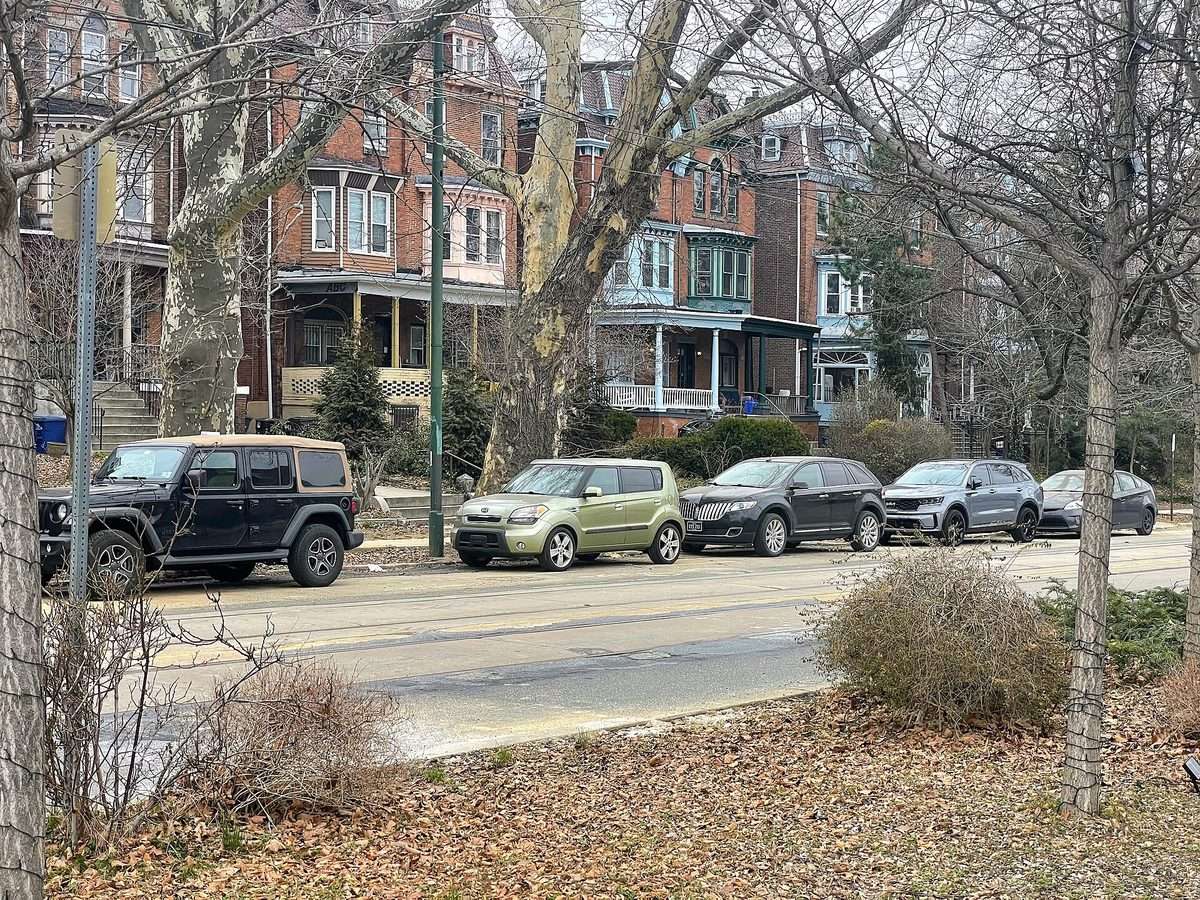
Victorian twins, porches, and towers
Spruce Hill and Cedar Park are the porch-front neighborhoods: big Victorian twins and singles with wraparound porches, three-story rowhomes, and a student-rental share that shapes everything. Closer to Penn and Drexel the stock turns into apartment and condo towers, and around 30th Street Station the Schuylkill Yards high-rises are going up beside a rebuilt Drexel Station.
For the loan, the Victorian twin is the interesting case. Many were cut into apartments decades ago, and the lender cares about the legal unit count, because a “single-family” with three kitchens is a three-unit in the appraiser’s eyes. Owner-occupants can buy a two- to four-unit with FHA at 3.5% down, and the duplex and triplex page covers how the rent counts. Old roofs, old wiring, and porch paint draw the usual FHA and VA notes.
What it costs
Prices here move on small samples, and the public data lags. Redfin’s University City page showed a $375,000 median in October 2025, down 10.7%, with 77 days on market. Spruce Hill ran about $520,000 in the same month and Cedar Park about $600,000 in September 2025. West Philadelphia as a whole came in at $208,000 in March 2026. Take all of it as a range and get a lender to pull current comps for the block you want.
At $375,000, Philadelphia’s 4.578% transfer tax is $17,168, with your customary half at $8,584. At $520,000 it’s $23,806 and $11,903. Property tax is 1.3998% of assessed value; with the $100,000 homestead exemption, a house assessed at $375,000 runs about $3,850 a year. The closing costs guide has the rest of the line items.
The programs that make this neighborhood different
Penn and Penn Medicine employees who are full-time and benefits-eligible can get a $7,500 forgivable loan through Penn Home Ownership Services, forgiven over five years, for a house within the program boundary (roughly Market Street to Paschall Avenue and the Schuylkill to 56th Street, plus housing across from Pennovation Works). Penn adds a closing cost reduction of 0.25% of the loan amount inside that boundary. Since 1998 more than 1,200 employees have used it.
Drexel’s Home Purchase Assistance Program pays $15,000, forgiven 20% a year over five years, for benefits-eligible faculty and staff buying between 31st and 48th Streets, Girard Avenue to Chestnut Street. It’s open to repeat buyers, and there’s a $5,000 renovation loan and a $2,500 match on top.
Philadelphia Home Buy Now, the city’s employer match, adds up to $4,000 for households under 115% of area median income whose employer participates; Penn, Drexel, Temple, and Saint Joseph’s do. Stack that with Philly First Home (up to $10,000 for first-time buyers under $85,900 for one person or $122,700 for four, counseling before the Agreement of Sale) and a Drexel employee buying a $375,000 twin can bring $29,000 in help to the table before PHFA’s K-FIT adds 5% more. The first-time buyer page shows how each layer fits.
You’re bidding against landlords
Student demand near Penn and Drexel means investors bid on the same twins you do, often in cash, and a DSCR loan lets them qualify on the rent alone. Your edge as an owner-occupant is the down payment: 3.5% FHA or 3% conventional against their 15% to 25%, plus the grants above. Write the offer with a real pre-approval and a lender who does two- to four-unit houses in West Philly, and ask early about the rental license status of any unit that’s currently rented. The investment property page explains what you’re up against.
Condos near campus have their own test. The towers along Chestnut and Walnut and the smaller conversions off Baltimore Avenue need a building that passes the lender’s project review: owner-occupancy ratio, reserves, no single owner holding too many units, no active litigation. Philly First Home excludes condos, though the employer programs don’t.
Penn’s forgivable loan and Drexel’s both come with boundaries drawn on a map. One block outside the line and the $7,500 or $15,000 disappears. Check the address against the map before you write the offer, and we’ll help you read it.
Baltimore Avenue and the trolley
The Baltimore Avenue Dollar Stroll returns Thursday, September 3, 2026, 5 to 8 p.m., with $1, $3, and $5 deals from 40th to 51st and block parties in Clark Park and Cedar Park. The trolleys on Baltimore, Chester, and Woodland are due for modernization: design finishes in 2026, construction runs 2027 to 2030, and new low-floor cars and stations follow. Expect construction first and better service later, in that order, as is tradition.
Start with one call
Tell us where you work and the block you’re looking at. We’ll check the employer map, and the lender who calls you back does West Philly twins and multi-units and knows how the employer loans, the city match, and Philly First Home fit together. Call us.